
client
Department of Education

service
Advisory

location
Logan Reserve, QLD

category
Education

completed
2024
Project Overview
The Project
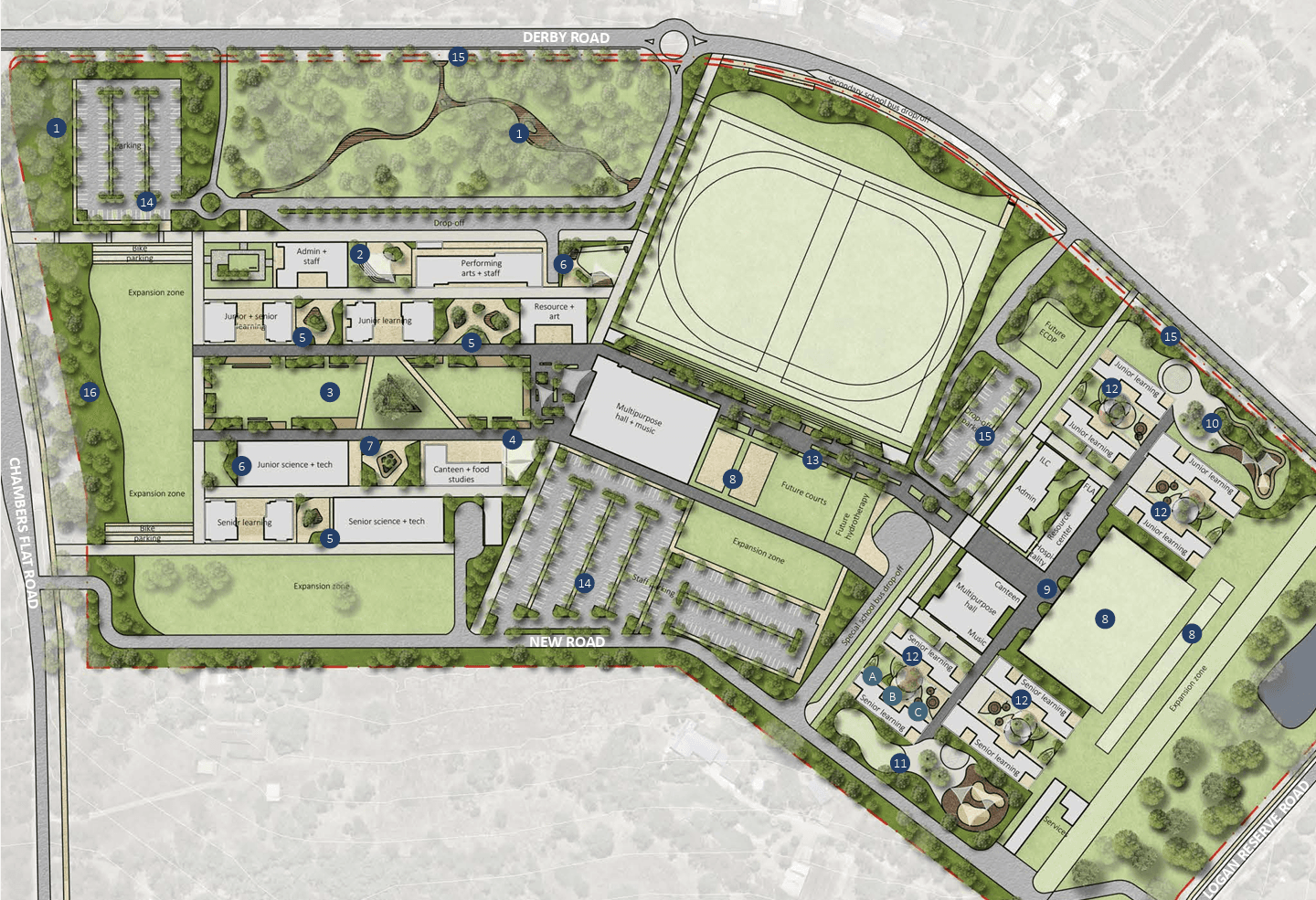
The Logan Reserve Secondary and Special Schools project is a major new education development responding to the rapid growth of one of Queensland's fastest expanding communities. Spanning nine allotments across Derby Road, Chambers Flat Road, and Logan Reserve Road, the site is being amalgamated to create two dedicated school precincts — a secondary school to the west and a special school to the east — to be delivered concurrently under a fast-track methodology with classrooms required for Queensland students by 2027.
The scale and complexity of delivering two distinct school communities on a single site, within an aggressive timeline, demanded rigorous planning and procurement thinking before a single contract was signed.
What is being delivered
The secondary school precinct comprises eight new buildings across the initial stage — two learning centres, administration, performing arts and music centre, multipurpose hall, resource and art centre, junior STEM building, operational services, and a food studies centre — with future stages adding a senior STEM building and third learning centre.
The special school precinct delivers eleven purpose-built facilities — multiple learning centres, sensory spaces, multipurpose hall, administration, and operational services — purpose-designed for young people with diverse needs and creating one of the most comprehensive special school environments in the region.
Our role
During the business case phase, Brad Eathorne provided independent buildability and procurement advisory to Donald Cant Watts Corke — covering construction methodology, programme development, works sequencing, and risk and opportunity identification — all focused on a single critical outcome: classrooms available for Queensland students by the 2027 school year.
The engagement covered the full complexity of delivering two schools concurrently on a single amalgamated site — identifying the constraints, the dependencies, and the procurement approach most likely to protect the programme and deliver the outcome the community needed.